Hi, I'm Arun Bhat 👋 CTO at FinnDot.
At FinnDot, we spend a lot of time thinking about money how people earn it, save it, invest it, and sometimes lose it. But we realized something interesting:
Most of us spend years earning money without ever understanding what money actually is.
That's why we at FinnDot are starting "What the Finn?"
Every 15 days, we'll pick one interesting topic about money, finance, psychology, investing, or the economy and break it down into a simple 5-minute read.
- No complicated jargon.
- No boring textbook definitions.
- Just practical ideas, interesting stories, and a few "Wait... what the Finn?" moments that might change the way you think about money.
So, let's begin with the most fundamental question...
What Exactly Is Money? 💰
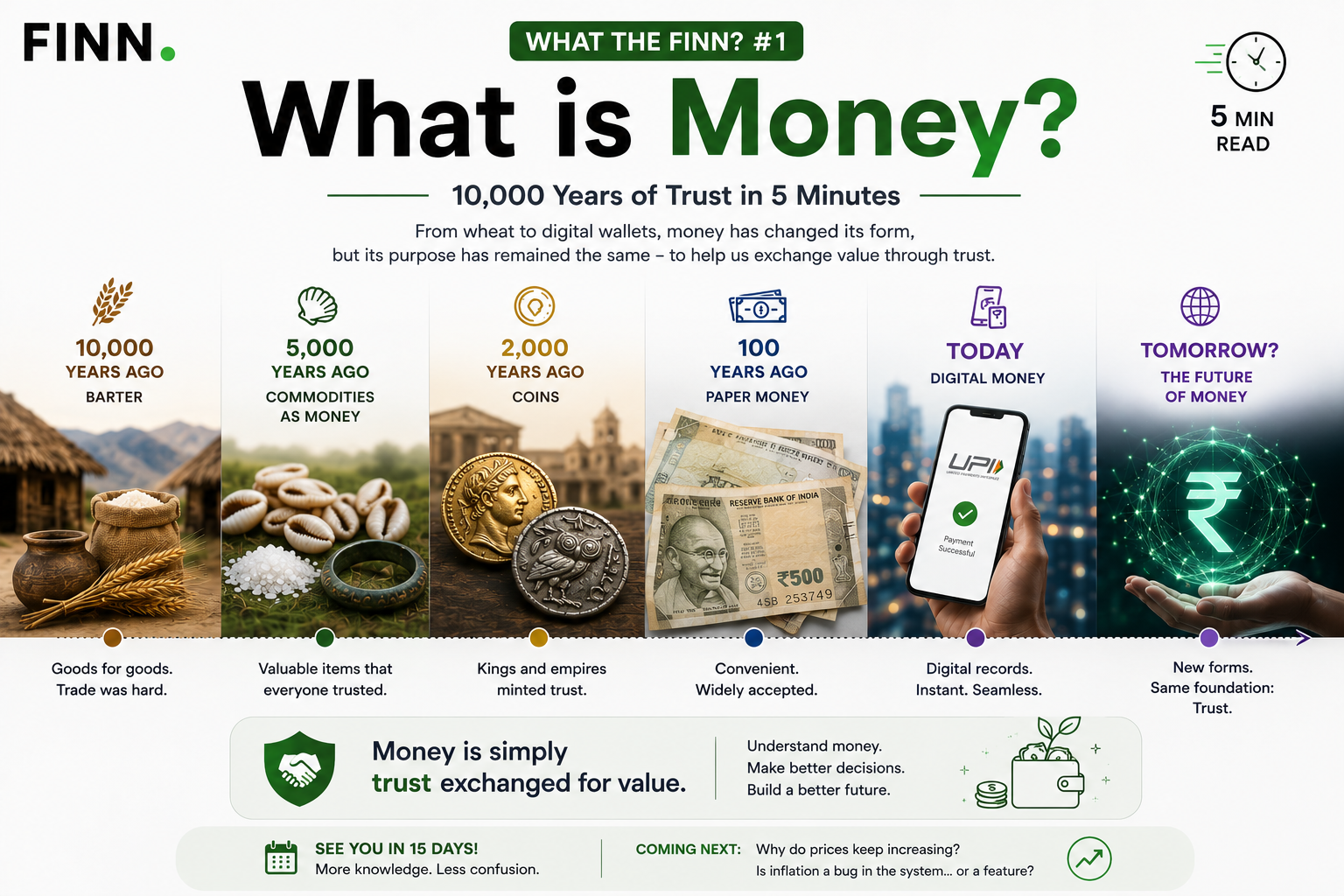
Imagine Life 10,000 Years Ago
You're living in a small village.
You grow wheat.
Your neighbor raises goats.
Another family makes pottery.
Now suppose you want milk.
You walk over to the goat farmer and offer some wheat.
He says,
"Sorry... I already have enough wheat. Got any fish?"
Now you're looking for a fisherman before your cereal gets cold.
Welcome to barter.
The biggest problem wasn't the lack of goods.
It was finding someone who wanted exactly what you had, exactly when you had it.
Trade was slow.
Trade was frustrating.
Almost like waiting for customer support.
Human civilization needed something better.
Around 5,000 Years Ago
People gradually began accepting items that everyone considered valuable.
Depending on where you lived, these included:
- Salt
- Cowrie shells
- Beads
- Livestock
- Copper
- Silver
These objects became an early form of money.
Not because they had magical powers.
But because people trusted that someone else would also accept them tomorrow.
Money had already become something much bigger than an object.
It had become shared trust.
Around 2,000 Years Ago
Kingdoms began minting coins from gold, silver, and copper.
The metal itself had value.
The king's seal guaranteed authenticity.
Trade expanded rapidly.
Empires grew.
Businesses flourished.
Money became portable.
Reliable.
Recognizable.
Even counterfeiters probably thought,
"Now that's a business opportunity."
Yet Human Nature Never Changed...
More than 2,000 years ago, Shri Adi Guru Shankaracharya observed something that remains remarkably relevant today:
"Yāvat vittopārjana śaktaḥ tāvan nija parivāro raktaḥ."
Translation:
"As long as a person is capable of earning wealth, the family(people) remains attached to them."
He later explains that this attachment is part of Maya (illusion) and that we should strive to rise above it.
Back to our topic...
His message highlights the profound influence money has on relationships.
Whether we like it or not, society often gives greater respect to those who possess wealth.
Different coins.
Different kingdoms.
Different clothes.
The same human software.
Money has always been more than currency.
It shapes:
- Respect
- Security
- Status
- Freedom
- Relationships
Today's Money Isn't Even Physical
Look around.
When was the last time you carried a large amount of cash?
Today, most of our money exists only as numbers stored in computers.
When you receive your salary...
Nothing physical moves.
A bank simply updates a database.
When you scan a QR code...
No coins change hands.
Just digital records.
Unlike ancient gold coins, modern money is no longer backed by gold in most countries.
Instead, it is backed primarily by one thing:
Trust.
Trust in banks.
Trust in governments.
Trust that everyone else will continue accepting it tomorrow.
After thousands of years, the technology has changed.
The idea hasn't.
But Here's the Catch...
Modern money quietly loses value.
Not because someone steals it.
But because of inflation.
Think of it as your favorite restaurant serving a smaller samosa every year... while charging the same price.
Your bank balance might look bigger.
But your purchasing power could actually be shrinking.
That's why simply saving money is often not enough.
Your money needs to work just as hard as you do.
So... What Comes Next?
No one knows for certain.
Perhaps we'll see:
- Central Bank Digital Currencies (CBDCs)
- Cryptocurrencies
- AI-managed financial systems
- Energy (Elon strongly believes this)
Maybe one day your AI assistant will negotiate your grocery bill better than you can.
Who knows?
The form of money will continue to evolve.
But one thing probably won't.
Money will continue to represent trust.
So, How Should We Treat Money?
Maybe we've been asking the wrong question.
Instead of asking,
"How do I earn more money?"
Perhaps we should first ask,
"What role should money play in my life?"
Money is not the destination.
It's a tool.
A tool that can buy:
- Time
- Freedom
- Security
- Experiences
- Opportunities
Money should serve you.
You shouldn't spend your entire life serving money.
Earn it wisely.
Invest it patiently.
Protect it carefully.
One day, if you do it right...
Your money might finally start working the night shift for you.
What the Finn? 💰
Money has changed from wheat...
to shells...
to gold...
to paper...
to invisible numbers on a screen.
Its appearance keeps changing.
Its purpose remains the same.
Money is simply trust exchanged for value.
At FinnDot, we believe understanding money is the first step toward making better financial decisions.
If this article made you pause for a minute and think, "What the Finn... I never looked at money that way," then we've done our job.
See you in 15 days!