Last time, we learned that money is simply trust exchanged for value.
Today, let's meet money's biggest enemy.
No...
It's not online shopping.
It's not your weekend food delivery.
And it's definitely not your friend who still "forgets" to return ₹500.
It's something much sneakier.
Inflation.
The Locker Experiment
Imagine you have a locker.
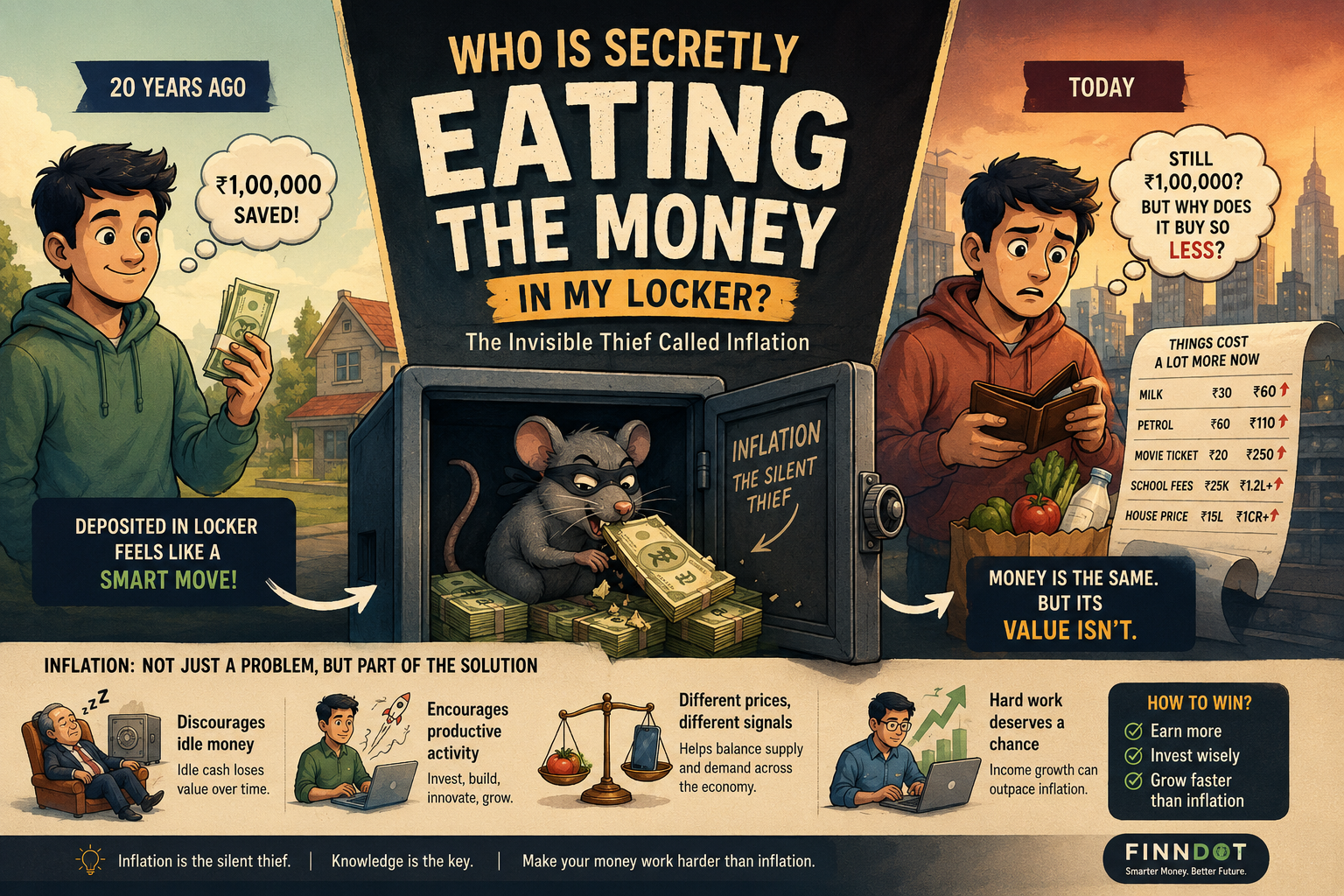
Inside it, you keep ₹1,00,000 in cash.
You lock it.
Hide the key.
Forget about it.
Twenty years later, you proudly open the locker.
Every note is still there.
Nothing has been stolen.
So you're still rich...
Right?
Not really.
The same ₹1,00,000 that once bought a small car may now buy only a good motorcycle.
The apartment your parents bought for ₹15 lakh might now cost over ₹1 crore.
The ₹20 movie ticket became ₹250.
And popcorn somehow became more expensive than the movie.
Nobody touched your locker.
Yet something disappeared.
Your purchasing power.
That's inflation.
Inflation Doesn't Eat Money...
It Eats What Money Can Buy.
This is one of the biggest misconceptions.
Inflation doesn't reduce the number of rupees you own.
It reduces the number of things those rupees can buy.
Your wallet stays the same.
Your shopping bag becomes smaller.
But Wait...
If Inflation Is So Bad...
Why Doesn't the Government Just Stop It?
Excellent question.
Because surprisingly...
A little inflation is actually good.
Let's understand why.
Imagine There Was ZERO Inflation
Suppose prices never increased.
Ever.
A family earns ₹100 crore today.
They lock it inside a vault.
After 100 years...
It still has exactly the same purchasing power.
Meanwhile...
Thousands of entrepreneurs build companies.
Scientists invent medicines.
Engineers build technology.
Doctors save lives.
Workers become more productive.
Yet the family that simply locked away money remains just as wealthy as before.
That doesn't create a very dynamic economy.
Money should move.
Not sleep.
Inflation Nudges Money Into Action
Inflation quietly tells us:
"If your money is sleeping... it will slowly become weaker."
That encourages people to:
- Invest
- Start businesses
- Lend money
- Build factories
- Buy productive assets
- Innovate
Instead of simply hiding cash inside lockers.
Think of inflation as a tiny "storage fee" on idle money.
It's the economy's way of saying,
"Use your money to create value."
Does Inflation Punish Rich People?
Not exactly.
It punishes idle cash.
A billionaire holding ₹100 crore in cash loses purchasing power.
A school teacher keeping emergency savings also loses purchasing power.
Inflation doesn't care who you are.
It only asks one question:
"Is your money growing faster than me?"
If yes...
You become wealthier.
If not...
You quietly become poorer.
Why Doesn't Everything Become Expensive Together?
Have you noticed?
Phones today are far better than they were 10 years ago.
Yet they haven't become 10 times more expensive.
Televisions became cheaper.
Internet became cheaper.
Computers became faster.
But...
Education became expensive.
Healthcare became expensive.
Real estate became expensive.
Why?
Because there isn't one inflation.
There are hundreds.
Every product has its own story.
Inflation Is Actually Information
Prices are messages.
Imagine tomatoes suddenly become expensive.
Farmers notice.
Next season...
More farmers grow tomatoes.
Supply increases.
Prices fall again.
Now imagine mobile phone chips become cheaper to manufacture.
Companies reduce prices.
Consumers benefit.
Resources naturally move toward where society needs them most.
Inflation and changing prices help the economy continuously rebalance itself.
It's like traffic signals.
Sometimes green.
Sometimes red.
Always guiding movement.
Then Why Does Everyone Hate Inflation?
Because there is a healthy amount...
and an unhealthy amount.
Imagine exercising.
A little exercise makes you healthier.
Too much sends you to the hospital.
Inflation works similarly.
Around 2–4% is often considered healthy in many economies.
At 15%...
People stop planning.
Businesses struggle.
Savings disappear.
At 100%...
Money starts losing its purpose.
People rush to spend salaries before prices rise again.
That's called hyperinflation.
History has shown countries where people carried bags full of cash just to buy bread.
Not because they became richer.
Because their money became almost worthless.
So How Do We Beat Inflation?
Not by hiding money.
Not by pretending inflation doesn't exist.
The answer is simple.
Your money should grow faster than inflation.
If inflation is 6%...
and your money grows by 10%...
You became wealthier.
If your money grows by only 3%...
You became poorer...
even if your bank balance increased.
That's why investing matters.
Saving protects your money.
Investing protects your future purchasing power.
What the Finn? 💰
Inflation is probably the only thief...
that can steal from your locker...
without opening it.
Without touching your cash.
Without leaving fingerprints.
It quietly steals your purchasing power.
But it also serves an important purpose.
It encourages money to move.
To build.
To invest.
To innovate.
To create.
At FinnDot, we believe understanding inflation isn't just about knowing why prices increase.
It's about understanding how an entire economy stays alive.
The next time someone says,
"My money is perfectly safe in my locker."
You can smile and say,
"Safe from thieves? Maybe. Safe from inflation? Definitely not."
See you in 15 days!